Vitiligo Care That
Addresses the Whole Picture
Vitiligo is an autoimmune condition in which the immune system targets pigment-producing cells in the skin. At Skin Harmony MD, care combines evidence-based dermatology with thoughtful attention to related autoimmune conditions, nutrition, stress, lifestyle, and other factors that may be relevant to your individual disease pattern.
Book a Discovery Call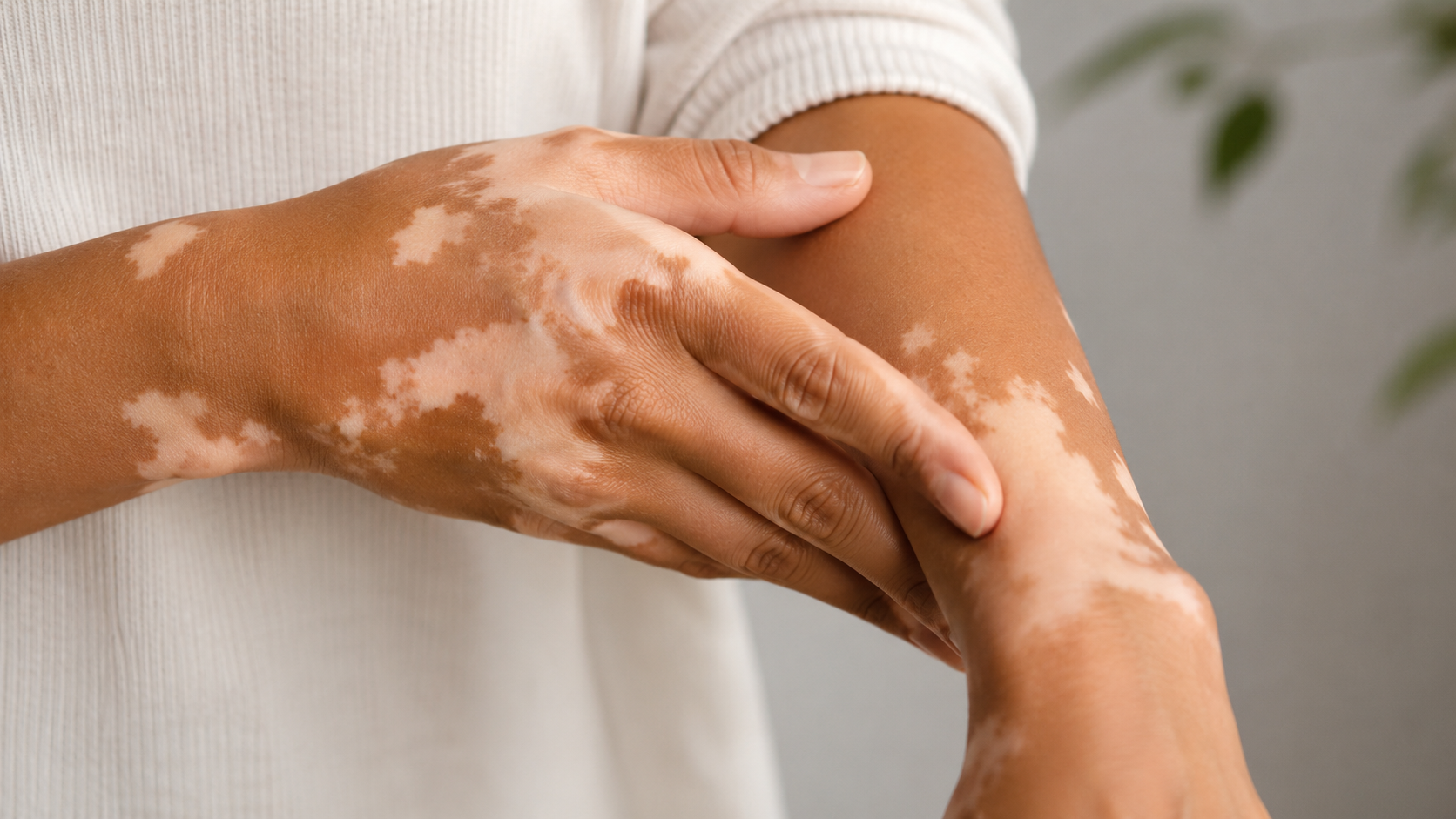
You May Be Looking for a Different Kind
of Vitiligo Care If…
- You want to better understand your vitiligo and whether related health conditions may be relevant.
- You're curious about how nutrition, stress, lifestyle, and overall health may fit into the broader picture.
- You want evidence-based vitiligo treatment while also considering your overall health.
- You'd like more time with a dermatologist to understand your treatment options and what may influence disease activity.
- You want a dermatologist who leaves space for evidence-informed complementary approaches alongside medical treatment.
- You want a personalized plan rather than a one-size-fits-all approach.
Vitiligo Is an Autoimmune Disease
— Not Just a Change in Pigment
Vitiligo affects pigmentation, but the biology extends beyond pigment alone. It is an autoimmune condition with a course that can vary significantly from person to person. Some people have a few stable patches, while others experience periods when new areas develop or existing areas expand.
What Is Vitiligo?
Vitiligo is an autoimmune condition in which the immune system mistakenly attacks melanocytes, the pigment-producing cells in the skin. This leads to white patches that can appear anywhere on the body, including the face, hands, arms, legs, scalp, and genital area.
The pattern, extent, and rate of progression vary widely. Some people have vitiligo that remains stable for years, while others experience periods of more active disease.
What Can Influence Vitiligo?
Vitiligo develops through a combination of genetic, immune, and cellular factors. Several associated health issues may also be relevant.
- Autoimmune activity. Vitiligo is an autoimmune disease in which the immune system targets the body's pigment-producing cells.
- Genetics. Vitiligo can run in families, although having a family history does not mean the condition will necessarily develop or progress.
- Oxidative stress. Research suggests oxidative stress may contribute to melanocyte injury and play a role in vitiligo. Antioxidant-based strategies have also been studied as an adjunct to standard treatment.
- Thyroid disease. Vitiligo is associated with autoimmune thyroid disease, particularly Hashimoto's thyroiditis. Thyroid evaluation may be appropriate based on your history, symptoms, family history, and other risk factors.
- Other autoimmune conditions. Vitiligo can occur alongside other autoimmune diseases. When your history suggests another condition may be present, further evaluation may be appropriate.
- Skin injury and friction. New areas of vitiligo can sometimes develop at sites of repeated friction, pressure, or skin injury. This is known as the Koebner phenomenon.
- Nutritional factors. Nutritional status may be relevant in some patients. When a specific deficiency is suspected or identified, correcting it can be incorporated into the broader treatment plan.
- Stress. Some patients report changes in disease activity during periods of significant physical or emotional stress, although the relationship varies from person to person.
Not every factor applies to every patient. The goal is to understand your individual disease pattern and health history rather than assume the same factors are relevant for everyone with vitiligo.
The Integrative Approach at Skin Harmony MD
Evidence-based vitiligo treatment remains the foundation of care. Our integrative approach also looks more broadly at your autoimmune history, related medical conditions, nutrition, stress, lifestyle, and other factors that may be relevant to your individual health and disease pattern.
What Comprehensive
Vitiligo Care Looks Like
A Thorough Evaluation of Your Full Picture
This helps us understand your individual presentation and identify which related health factors may be worth exploring.
Targeted Evaluation & Testing
Thyroid evaluation may be appropriate because of the known association between vitiligo and autoimmune thyroid disease. Additional testing or referral may be considered when your symptoms, medical history, or family history suggest another autoimmune condition or a specific nutritional deficiency.
Medical Dermatology as the Foundation
Phototherapy
Treatment typically requires consistency over several months, and response varies by individual and body location. When appropriate, we can incorporate phototherapy into your treatment plan through referral to a local dermatology or phototherapy center.
Nutrition & Antioxidant Support
We emphasize a nutrient-dense, predominantly whole-food eating pattern with a variety of plant foods and may consider targeted supplementation when appropriate. Recommendations are individualized based on your health history, nutritional needs, and overall treatment plan.
Stress & Lifestyle Support
Evidence-Informed Complementary Approaches
Vitiligo Can Affect More Than
the Skin
Thyroid Health
Other Autoimmune Conditions
Emotional Health & Quality of Life
Vitiligo,
Answered Honestly
Yes. Vitiligo is associated with autoimmune thyroid disease, particularly Hashimoto's thyroiditis.
Thyroid evaluation may be appropriate depending on your symptoms, personal and family history, and other risk factors. Not every patient requires the same testing.
Research suggests oxidative stress may contribute to melanocyte injury in vitiligo, and antioxidant strategies have been studied as an adjunct to conventional treatment.
The evidence is still evolving, so these approaches are best considered supportive rather than a replacement for established medical therapies.
Narrowband UVB phototherapy is one of the most established treatments for vitiligo.
It is typically used consistently over an extended period — often several months — and results vary by body location and individual response. It is frequently combined with topical therapy.
We consider supplements in the context of your individual health and treatment plan.
When a nutritional deficiency is identified, targeted supplementation may be appropriate. Certain antioxidant-based supplements have also been studied in vitiligo, although the evidence varies depending on the specific approach.
We’ll discuss why a supplement may be useful and its potential risks and benefits before making a recommendation.
Vitiligo's course is highly individual.
Some people have stable disease for years, while others experience periods of active spread. Early and consistent treatment may help stabilize active disease and promote repigmentation, although response varies.
When appropriate, we can incorporate evidence-informed complementary approaches alongside medical treatment, taking into account your individual goals, preferences, and health history.
Yes. Skin Harmony MD is a dermatology practice.
Treatment may include prescription topical therapies and referral for phototherapy when appropriate. Our integrative approach means we consider these treatments alongside autoimmune health, nutrition, stress, lifestyle, and related medical conditions when relevant.
No. Some patients choose Skin Harmony MD as their primary dermatology practice, while others continue seeing another dermatologist for services that require in-person care, such as phototherapy or procedures.
Yes. Skin Harmony MD is a virtual integrative dermatology practice serving adults throughout Maryland, Virginia, and Washington, DC.
Visits are conducted via telehealth and are cash-pay, allowing us the time and depth this type of care requires.

Comprehensive Vitiligo Care, Built Around You
Virtual vitiligo care for adults throughout Maryland, Washington, DC, and Virginia — combining evidence-based dermatology with the time and attention to understand your disease pattern and the broader health factors that may be relevant to you.
Book a Discovery Call