Seborrheic Dermatitis Care
That Goes Beyond the Surface
Seborrheic dermatitis is a chronic inflammatory condition that can affect the scalp, face, and other oil-rich areas of the skin. At Skin Harmony MD, we combine evidence-based dermatologic treatment with thoughtful attention to scalp and skincare, personal triggers, stress, lifestyle, and other factors that may influence your symptoms.
Book a Discovery Call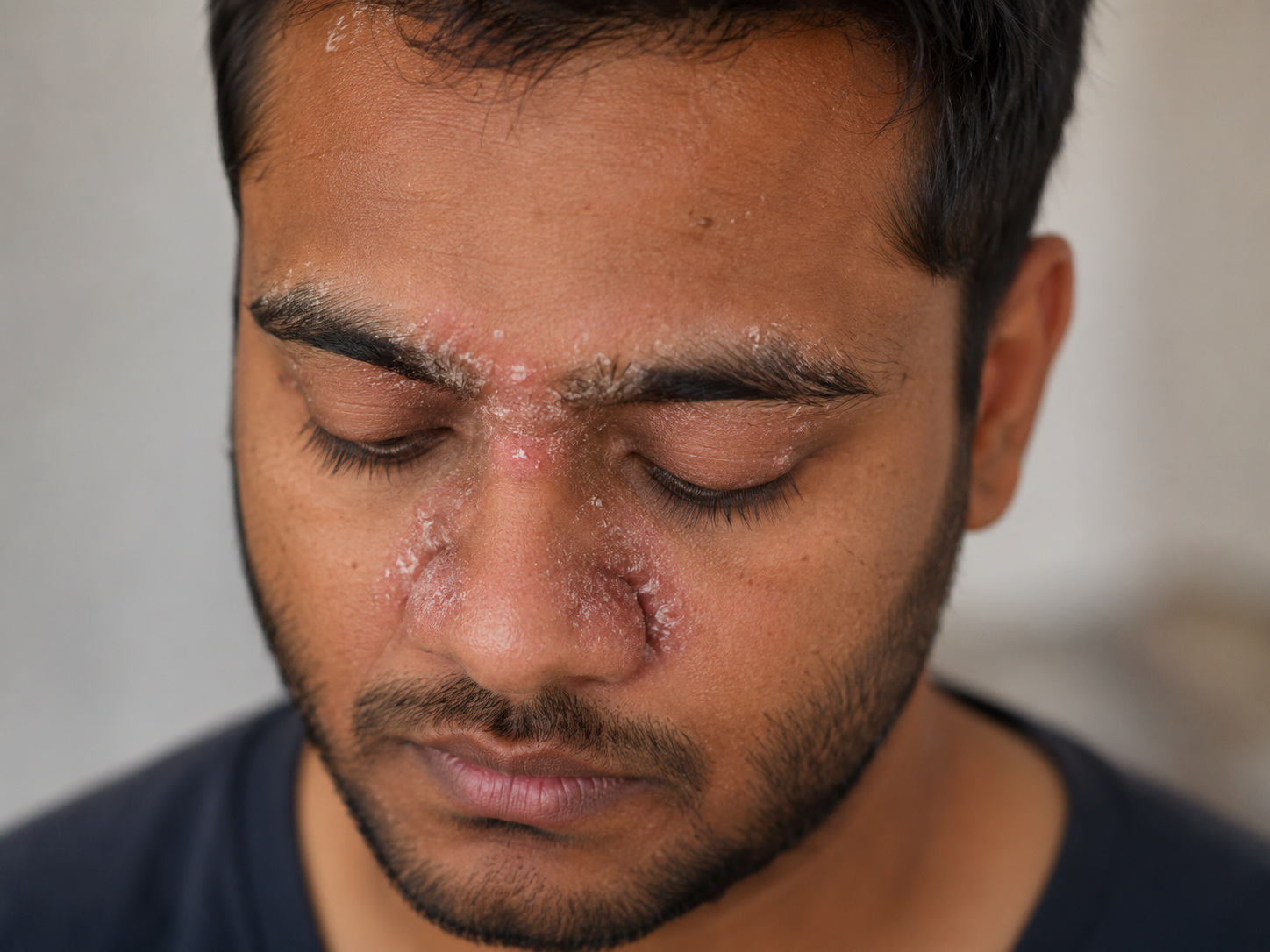
You May Be Looking for a Different Kind
of Seborrheic Dermatitis Care If…
- You're tired of repeatedly treating flaking only to have it return.
- You want to better understand your personal triggers and how skincare, stress, and lifestyle may affect your condition.
- You want evidence-based treatment along with a realistic plan for long-term control.
- You'd like more time with a dermatologist to understand your treatment options.
- You want a personalized plan rather than a one-size-fits-all approach.
- You want a dermatologist who leaves space for evidence-informed complementary approaches alongside medical treatment.
An Inflammatory Condition
— Not Simply a Yeast Infection
Seborrheic dermatitis causes red, flaky, itchy, and sometimes greasy patches on the scalp, face, and other oil-rich areas of the skin. A naturally occurring yeast called Malassezia plays an important role, but the condition also involves inflammation, skin oils, the skin barrier, and individual susceptibility.
What Is Seborrheic Dermatitis?
Seborrheic dermatitis is a chronic inflammatory skin condition associated with Malassezia, a yeast that normally lives on the skin.
In susceptible individuals, interactions between Malassezia, skin oils, inflammation, and the skin barrier contribute to redness, scaling, itching, and irritation.
It often affects the scalp, where it may appear as dandruff, but can also involve the eyebrows, sides of the nose, ears, eyelids, beard area, and chest.
What Can Influence Seborrheic Dermatitis?
Several factors can affect how seborrheic dermatitis behaves.
- Malassezia and inflammation. Malassezia naturally lives on the skin and plays an important role in seborrheic dermatitis. The condition appears to involve both the yeast and the skin's inflammatory response to it.
- Oil production. Seborrheic dermatitis tends to occur in areas with more sebaceous glands and skin oils.
- Skin-barrier function. Irritated or disrupted skin may become more sensitive and prone to redness, itching, and scaling.
- Skin microbiome. Researchers have identified differences in the microbial communities present on skin affected by seborrheic dermatitis, although the clinical significance of these findings is still being studied.
- Stress. Many patients report worsening during periods of increased stress.
- Weather and season. Cold, dry weather can worsen symptoms in some people.
- Skin and hair products. Certain styling products, harsh cleansers, fragrances, or other irritating products may aggravate sensitive skin or scalp.
- Nutrition. Some studies have explored associations between dietary patterns and seborrheic dermatitis, but no specific diet has been proven to treat the condition.
- Your individual pattern. Seborrheic dermatitis behaves differently from person to person. Understanding when and how your symptoms flare can help identify the factors most relevant to you.
Understanding your own flare pattern helps us create a realistic long-term plan rather than simply treating each episode as it occurs.
The Integrative Approach at Skin Harmony MD
Our integrative approach combines evidence-based dermatologic treatment with time to understand your scalp and skincare routine, personal triggers, stress, lifestyle, nutrition when relevant, and other factors that may be influencing your symptoms. The goal is not simply to treat the current flare, but to create a practical plan for keeping your skin and scalp better controlled over time.
What Comprehensive Seborrheic
Dermatitis Care Looks Like
A Thorough Evaluation of Your Full Picture
This helps us understand your individual pattern and personalize treatment.
Targeted Evaluation & Testing
When your history suggests another medical condition or a specific nutritional deficiency, targeted evaluation may be considered. Testing is used selectively when the results are likely to meaningfully change care.
Medical Dermatology as the Foundation
Once symptoms are controlled, intermittent maintenance treatment can often help reduce how frequently they return.
Scalp & Skin Care
We review how to use medicated shampoos and topical treatments effectively while minimizing products or practices that may worsen irritation.
Supporting the Skin Barrier
Nutrition & Lifestyle
We generally encourage a nutrient-dense, plant-forward or Mediterranean-style eating pattern that includes sources of healthy fats, including omega-3 fatty acids, for overall health and its potential anti-inflammatory benefits.
When you notice a consistent relationship between certain foods and your symptoms, we can explore that pattern individually without recommending unnecessary dietary restriction.
Stress, Sleep & Lifestyle
Evidence-Informed Complementary Approaches
Living With a Chronic,
Recurring Skin Condition
Stress & the Mind-Skin Connection
Skin Barrier & Microbiome
Recurrence & Long-Term Control
Seborrheic Dermatitis,
Answered Honestly
Seborrheic dermatitis is a chronic condition, so it tends to come and go.
Treatment can clear a flare, but many patients benefit from intermittent maintenance therapy to keep symptoms controlled.
No.
Seborrheic dermatitis is not caused by being unclean. It is an inflammatory condition associated with Malassezia yeast, skin oils, skin-barrier function, and individual susceptibility.
Not exactly.
Malassezia yeast plays an important role, which is why antifungal treatments can work very well. But seborrheic dermatitis also involves inflammation and the way the skin responds to the yeast.
Yes. Research suggests that changes in the balance of yeast and bacteria living on the skin, known as dysbiosis, can contribute to seborrheic dermatitis. Malassezia yeast plays an important role, and studies have also identified changes in bacterial communities on affected skin.
These microbial changes interact with inflammation, skin oils, and the skin barrier. Our approach considers these connected factors through appropriate treatment and thoughtful scalp and skincare. Research into additional treatments that specifically target the skin microbiome is still evolving.
Seborrheic dermatitis often requires some form of maintenance treatment.
Depending on your symptoms, that may include intermittent antifungal shampoo or topical therapy, gentle skincare, avoiding irritating products, and managing personal triggers.
For some people, yes.
Some patients notice a clear relationship between stressful periods and increased redness, itching, or flaking. When that pattern is present, stress-management and sleep strategies may be useful additions to medical treatment.
Research into diet and seborrheic dermatitis is still evolving. Some studies have found associations between dietary patterns and the condition, but no specific diet has been proven to prevent or treat it.
We generally encourage a nutrient-dense, plant-forward or Mediterranean-style eating pattern that includes sources of healthy fats, including omega-3 fatty acids, for overall health and its potential anti-inflammatory benefits.
If you notice a consistent relationship between certain foods and your symptoms, we can explore that pattern individually without recommending unnecessary dietary restriction.
It depends.
The ideal wash frequency varies depending on your scalp symptoms, hair type, hair-care practices, and the medication or shampoo being used.
We can help develop a routine that is effective without unnecessarily disrupting your hair-care needs.
We consider supplements in the context of your individual situation. If your diet, symptoms, medical history, or laboratory findings suggest a nutritional deficiency, targeted supplementation may be appropriate. We’ll discuss why a supplement may be useful and the potential risks and benefits.
We may incorporate selected evidence-informed complementary approaches when they fit your individual needs. These can be used alongside medical dermatologic treatment as part of a broader whole-person plan.
Yes. Skin Harmony MD is a dermatology practice.
Depending on the location and severity of your seborrheic dermatitis, treatment may include antifungal shampoos or creams, anti-inflammatory medications, and other prescription therapies.
Our integrative approach considers these treatments alongside scalp and skincare, triggers, stress, lifestyle, and nutrition when relevant.
No.
Some patients choose Skin Harmony MD as their primary dermatology practice, while others continue seeing another dermatologist for additional in-person dermatologic needs.
Yes. Skin Harmony MD provides virtual dermatology care for adults throughout Maryland, Virginia, and Washington, DC.
Visits are conducted via telehealth and are cash-pay, allowing us the time and depth this type of care requires.

Comprehensive Seborrheic Dermatitis Care, Built Around You
Virtual seborrheic dermatitis care for adults throughout Maryland, Washington, DC, and Virginia, combining evidence-based dermatology with the time and attention to understand your symptoms, triggers, and long-term treatment needs.
Book a Discovery Call