Rosacea Care That
Goes Beyond the Surface
Rosacea is a chronic inflammatory skin condition that can involve flushing, persistent redness, visible blood vessels, sensitivity, and acne-like bumps. At Skin Harmony MD, care combines evidence-based medical dermatology with thoughtful attention to skincare, individual triggers, stress, lifestyle, and digestive health when relevant.
Book a Discovery Call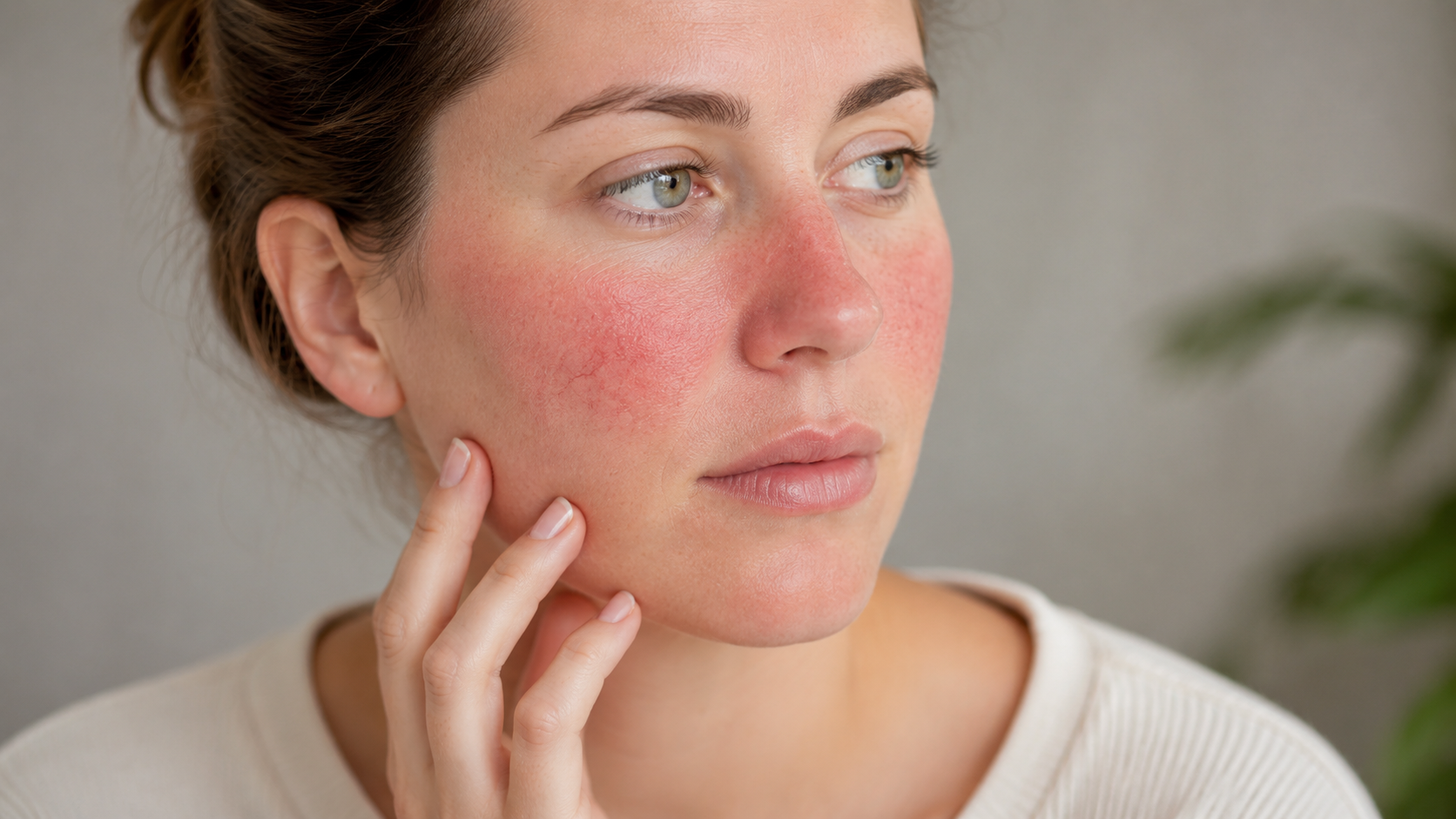
You May Be Looking for a Different Kind
of Rosacea Care If…
- You want to better understand what may be contributing to your flares.
- You're curious about how skincare, stress, lifestyle, digestive health, and everyday triggers may fit into the broader picture.
- You want evidence-based medical treatment while also addressing the factors that may influence your rosacea.
- You'd like more time with a dermatologist to understand your individual flare pattern and treatment options.
- You want a personalized plan rather than a one-size-fits-all approach.
- You want a dermatologist who leaves room for evidence-informed complementary approaches alongside medical treatment when they are appropriate for you.
Rosacea Is
More Than Facial Redness
Rosacea is a chronic inflammatory condition that most often affects the cheeks, nose, chin, and forehead. It can cause flushing, persistent redness, visible blood vessels, burning or stinging, and sometimes acne-like bumps.
What Is Rosacea?
Rosacea-prone skin tends to be more sensitive and reactive. Blood vessels may dilate more easily, the skin barrier may be more easily disrupted, and inflammatory and neurovascular pathways also appear to play a role.
What Can Influence Rosacea?
Rosacea is shaped by a combination of vascular, inflammatory, environmental, and individual factors.
- Skin sensitivity. Rosacea-prone skin is often more reactive and can be easily irritated by products, weather, heat, and environmental exposures.
- Blood-vessel reactivity. Blood vessels in rosacea-prone skin may dilate more easily, contributing to flushing and persistent redness.
- Individual triggers. Common triggers include heat, sun exposure, alcohol, spicy foods, hot beverages, intense exercise, emotional stress, wind, and cold. The exact pattern differs from person to person.
- Stress. Stress is one of the most commonly reported rosacea triggers and can contribute to flushing and flares.
- Harsh skincare. Fragrance, scrubs, alcohol-based products, over-cleansing, and other irritating products can worsen symptoms.
- Digestive health. Rosacea has been associated with gastrointestinal conditions including IBS, H. pylori infection, and SIBO. These associations do not mean that every patient with rosacea has a gut disorder, but digestive symptoms may be relevant in selected patients.
No two patients have exactly the same trigger pattern. Understanding your history, symptoms, skincare, and the factors most relevant to you helps us build a more personalized plan.
The Integrative Approach at Skin Harmony MD
Evidence-based dermatologic treatment remains the foundation of rosacea care. Our integrative approach looks at the broader picture, including your skincare routine, individual triggers, stress, lifestyle, and digestive health when clinically relevant, so treatment can be tailored to the factors that matter most for you.
What Comprehensive
Rosacea Care Looks Like
A Thorough Evaluation of Your Full Picture
This helps us identify the factors most relevant to your rosacea and build a more personalized treatment plan.
Targeted Evaluation & Testing
When a gastrointestinal condition is identified, we may recommend follow-up with primary care or gastroenterology when appropriate.
Medical Dermatology as the Foundation
We incorporate these evidence-based treatments alongside skincare, lifestyle, trigger management, and other relevant aspects of your care.
Gentle Skincare & Barrier Support
We focus on mild cleansing, regular moisturizing, daily broad-spectrum sunscreen, and products chosen to minimize irritation and support a healthy skin barrier.
Digestive Health When Relevant
If a condition such as H. pylori infection or SIBO is identified, we help make sure it is appropriately evaluated and treated.
Personal Trigger Identification
The goal is not to avoid everything. It is to understand your pattern so you can make informed choices and manage flares more effectively.
We also consider overall dietary patterns when relevant. Rather than recommending a restrictive rosacea diet, we focus on a balanced, fiber-rich, nutrient-dense eating pattern while identifying foods that consistently trigger symptoms for you.
Stress, Sleep & Mind-Body Support
When relevant, we consider stress, sleep, and mind-body or nervous-system regulation strategies as part of the broader treatment plan.
Evidence-Informed Complementary Approaches
Complementary approaches can be used alongside evidence-based medical treatment as part of an individualized plan.
Rosacea Can Affect More Than
How Your Skin Looks
Digestive Health
Stress & Emotional Health
Eye Symptoms
Rosacea,
Answered Honestly
Research has found associations between rosacea and several gastrointestinal conditions, including IBS, H. pylori infection, and SIBO.
That does not mean everyone with rosacea has a gut disorder or that treating the gut will necessarily improve rosacea.
We pay closer attention to digestive health when you also have gastrointestinal symptoms or other clinical clues that make further evaluation reasonable.
Common triggers include heat, sun exposure, alcohol, spicy foods, hot beverages, intense exercise, emotional stress, wind, and cold.
The exact combination is different for every person. Part of your care is learning your own trigger pattern so you can anticipate and manage flares more effectively.
Rosacea-prone skin is often very sensitive and easily irritated.
Harsh cleansers, fragranced products, scrubs, and over-exfoliation can worsen redness, burning, and stinging. A simple routine with a gentle cleanser, moisturizer, and daily broad-spectrum sunscreen can help reduce irritation and support the skin barrier.
Yes. A gentle moisturizer can help reduce dryness, burning, and irritation while supporting the skin barrier over time.
The key is choosing products that are simple, fragrance-free, and well tolerated by rosacea-prone skin.
While rosacea can be a chronic condition, our goal is to reduce flushing, redness, bumps, irritation, and the frequency of flares so that your skin is less reactive and your symptoms are easier to manage. We tailor care to you, combining medical treatment, gentle skincare, sun protection, and attention to your individual triggers and other contributing factors.
Yes. Stress is one of the most commonly reported rosacea triggers, and many people notice more flushing or redness during stressful periods. When relevant, stress-management, mind-body, and nervous-system regulation strategies may be included as part of the overall treatment plan.
Not necessarily.
These are common rosacea triggers, but not everyone reacts to the same things. We focus on identifying your personal pattern rather than giving you a long list of foods and activities to avoid.
Supplements may be considered depending on your individual clinical picture, nutritional status, and overall health. When we recommend one, we discuss why it may be useful as well as the potential benefits and risks.
Yes, selected evidence-informed complementary approaches may be incorporated when appropriate for your individual needs and goals. Because rosacea-prone skin can be very sensitive, we also consider whether a treatment is likely to support the skin or cause additional irritation. “Natural” does not always mean gentler or better.
Yes. Skin Harmony MD is a dermatology practice.
Depending on your rosacea pattern and severity, treatment may include topical or oral prescription medications, along with referral for laser or light-based treatment when appropriate.
Our integrative approach means we consider these treatments alongside skincare, triggers, stress, lifestyle, digestive health when relevant, and overall health.
No. Some patients choose Skin Harmony MD as their primary dermatology practice, while others continue seeing another dermatologist for services that require in-person care, such as procedures or laser treatment.
Yes. Skin Harmony MD is a virtual integrative dermatology practice serving adults throughout Maryland, Virginia, and Washington, DC.
Visits are conducted via telehealth and are cash-pay, allowing us the time and depth this type of care requires.

Comprehensive Rosacea Care, Built Around You
Virtual rosacea care for adults throughout Maryland, Washington, DC, and Virginia, combining evidence-based dermatology with the time and attention to understand your skin, your triggers, and the broader factors that may be relevant to your rosacea.
Book a Discovery Call