Perioral Dermatitis Care
That Goes Beyond the Surface
Perioral dermatitis is an inflammatory facial rash that often develops around the mouth, nose, or eyes. Topical steroids are a well-recognized trigger, while skincare products, cosmetics, irritation, and other individual exposures may also contribute. At Skin Harmony MD, care combines evidence-based medical dermatology with skincare simplification, barrier support, trigger identification, and lifestyle strategies when relevant.
Book a Discovery Call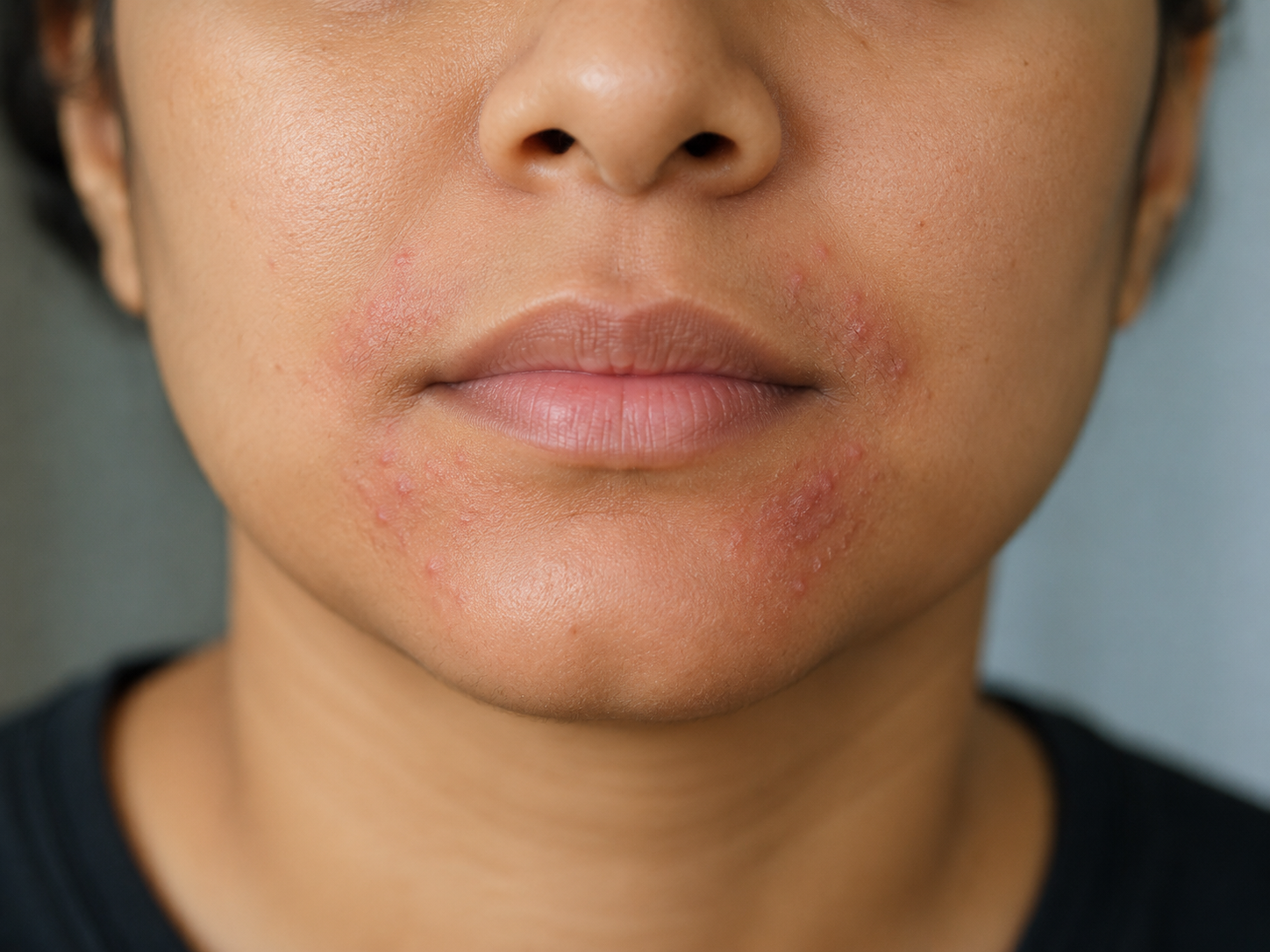
You May Be Looking for a Different Kind
of Perioral Dermatitis Care If…
- Your rash keeps returning even after treatment.
- You're overwhelmed by conflicting advice about which products to use or avoid.
- You want to understand what may be triggering or contributing to your rash.
- You want evidence-based treatment along with a simple, realistic skincare plan.
- You'd like more time with a dermatologist to understand what may be aggravating your skin.
Sometimes the Best Approach Is
Doing Less — Not Adding More
Perioral dermatitis can resemble acne, rosacea, or eczema, but it is a distinct inflammatory condition. It often appears as small red or skin-colored bumps around the mouth, nose, or eyes and may cause dryness, burning, itching, or sensitivity.
For many patients, repeatedly adding new products or treatments can further irritate already-sensitive skin.
What Is Perioral Dermatitis?
Perioral dermatitis — also called periorificial dermatitis — is an inflammatory facial skin condition that most commonly affects the area around the mouth. It may also occur around the nose or eyes.
The rash usually consists of small bumps with surrounding redness or scaling. Unlike acne, blackheads and whiteheads are generally absent.
Topical corticosteroids are one of the best-known triggers, although perioral dermatitis can also develop in people who have never used them.
What Can Influence Perioral Dermatitis?
Perioral dermatitis likely develops through a combination of inflammation, skin-barrier disruption, environmental exposures, and individual susceptibility.
- Topical corticosteroids. Facial steroid use is one of the strongest known triggers. Steroids may temporarily improve redness but can contribute to persistence or rebound when stopped.
- Skincare products and cosmetics. Heavy creams, multiple active ingredients, fragranced products, cosmetics, and frequent product changes may worsen irritation.
- Skin-barrier disruption. Irritated skin becomes more reactive to products and environmental exposures.
- Nasal and inhaled corticosteroids. These medications may contribute in some patients, although they should not be stopped without appropriate medical guidance.
- Oral-care products. Toothpaste and other oral-care products may contribute to irritation around the mouth in some individuals.
- Skin microbiome. Researchers are studying possible differences in the microorganisms present on affected skin, but the clinical significance of these findings remains uncertain.
- Hormonal influences. Changes around menstruation, pregnancy, or other hormonal shifts have been reported in some patients, although the role of hormones in perioral dermatitis is not fully understood.
- Stress and lifestyle. Stress and sleep are not established causes of perioral dermatitis, but some people notice that their skin feels more reactive during periods of increased stress or disrupted sleep.
Understanding what your skin is exposed to and what may be contributing to your rash can help us create a more targeted treatment plan.
The Integrative Approach at Skin Harmony MD
Evidence-based dermatologic treatment remains the foundation of perioral dermatitis care.
Our integrative approach adds careful review of skincare, medications, possible contributing factors, skin-barrier support, and lifestyle factors when relevant.
The goal is often not to add more products. It is to calm the skin and create a routine that is simple enough to maintain.
What Comprehensive Perioral
Dermatitis Care Looks Like
A Thorough Evaluation of Your Skin History
We also consider patterns you have noticed, including what seems to improve or worsen the rash, as well as hormonal, stress, or sleep-related changes when relevant.
Skincare Simplification
We identify potentially irritating products or ingredients and create a gentler routine while the skin is inflamed.
Medical Dermatology as the Foundation
Depending on the severity and extent of the rash, treatment may include topical medications or an oral medication for more persistent, widespread, or inflamed disease.
We use oral antibiotics judiciously and only when they are clinically appropriate.
Supporting the Skin Barrier
The routine does not need to be complicated. In many cases, fewer products are better while the skin is healing.
Identifying Relevant Exposures
Rather than giving everyone the same list of restrictions, we focus on what appears relevant to your individual skin.
Nutrition, Stress & Lifestyle
Evidence-Informed Complementary Approaches
Because inflamed facial skin can be especially reactive, we are thoughtful about products applied directly to the skin. Natural does not always mean gentle.
What Shapes Perioral Dermatitis
— and How It Affects You
Your Skincare Environment
Skin Barrier & Sensitivity
Emotional Health & Quality of Life
Perioral Dermatitis,
Answered Honestly
Perioral dermatitis can recur when the skin continues to be exposed to triggering or irritating factors.
Topical steroids are a common reason, but skincare products, cosmetics, oral-care products, and other individual exposures may also contribute.
No.
It can resemble acne because it causes small facial bumps, but it is a different inflammatory condition. Blackheads and whiteheads are usually absent.
Yes.
Topical steroids are one of the best-known triggers for perioral dermatitis. They may temporarily improve redness, but the rash can recur or worsen when the steroid is stopped.
Not necessarily.
Temporarily simplifying your routine and reducing irritating active ingredients can be very helpful while the skin is inflamed. The goal is not to permanently eliminate everything.
Certain oral-care products may contribute to irritation around the mouth in some people, but toothpaste is not a universal cause.
We consider oral-care products as one possible factor based on your history.
Possibly, but the exact role remains uncertain.
Researchers are studying changes in the skin microbiome in perioral dermatitis, but microbiome-directed treatments are not yet established.
There is no specific diet shown to be beneficial in perioral dermatitis.
However, if you notice that certain dietary or lifestyle patterns consistently seem to track with your skin flares, we can consider those patterns as part of the broader treatment plan.
Stress is not considered a primary cause of perioral dermatitis, but some people notice that their skin feels more reactive or flares during periods of increased stress or disrupted sleep.
Not everyone does.
Some cases respond to topical treatment and skincare changes alone. Oral antibiotics may be helpful for more persistent, widespread, or inflamed disease. We use them judiciously.
Some natural or complementary products may be reasonable to consider, but inflamed facial skin can be especially reactive. We are thoughtful about products applied directly to the skin, since essential oils, botanical extracts, fragrances, and other ingredients can sometimes cause additional irritation.
For many people, yes.
It can take several weeks or longer to fully settle, particularly after stopping topical steroids. With appropriate treatment and a simplified routine, most patients can achieve significant improvement.
No.
Some patients choose Skin Harmony MD as their primary dermatology practice, while others continue seeing another dermatologist for additional in-person dermatologic needs.
Yes. Skin Harmony MD provides virtual dermatology care for adults throughout Maryland, Virginia, and Washington, DC.
Visits are conducted via telehealth and are cash-pay.

Comprehensive Perioral Dermatitis Care, Built Around You
Virtual perioral dermatitis care for adults throughout Maryland, Washington, DC, and Virginia — combining evidence-based dermatology with the time and attention to understand your skin, contributing factors, and treatment needs.
Book a Discovery Call